Defending Democracy – Learning from the History of Football
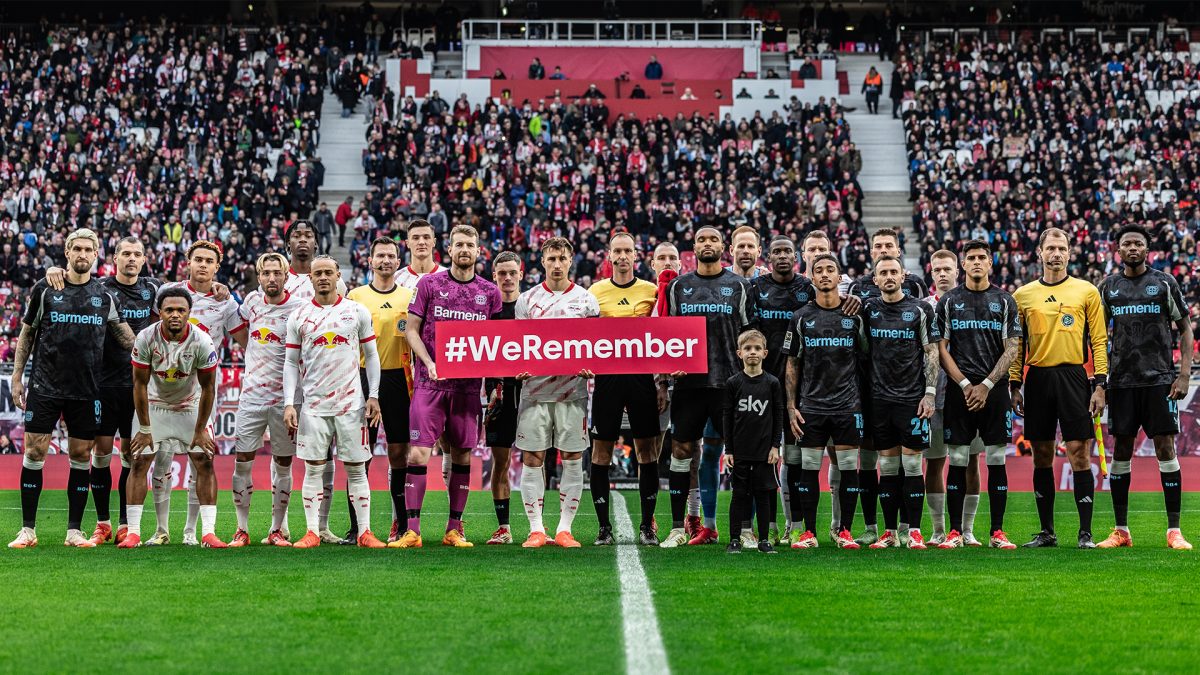
23 January 2026 – On January 27, 1945, the Auschwitz-Birkenau concentration and extermination camp was liberated. Every year around this date, German football together with the initiative “!Never Again” commemorates the people who were persecuted, deported, and murdered under National Socialism.
Sport and football – never apolitical
The Nazi regime exploited sport in various ways. Among other things, sport was intended to increase work morale and readiness for war, as well as to standardise leisure activities. Above all, sport served as a means of propaganda. The 1936 Olympic Games in Berlin were the sporting event par excellence, which the Nazis used to demonstrate their power and entrench their ideology – far beyond Germany’s borders.
German football, with its English roots and many Jewish pioneers such as Walther Bensemann — who was involved in founding the German Football Association (DFB) in 1900 and in 1920 launched the sports magazine “kicker” which is still popular today — was not immune to National Socialist hatred. On the contrary: many clubs actively participated in the disenfranchisement of Jewish citizens—even though the Nazi leadership initially refrained from enforcing this in sport out of consideration for the 1936 Olympic Games. In many places, top-down enforced conformity was not even necessary. Even for national players like Julius Hirsch, who became German champion in 1910 with Karlsruher FV, founded by Bensemann, there was no longer any place in their sport. Hirsch was murdered in Auschwitz.
Despite all this, many leading sports officials remained in office after 1945. It took more than half a century before clubs and associations began to address their role during the Nazi era.
What does this have to do with us today?
All this shows: political neutrality in sport is a fiction. Sports clubs are, by their organisational form, political institutions, as they are based on democratic core values and thrive on participation and equality.
A look at history shows: democracy is not a given. And almost always, when democracy comes under pressure, it is accompanied by antisemitic tendencies. Football, with its wide reach, has a responsibility to live and defend our democratic values. Active remembrance therefore means lived solidarity with Jewish people—especially when, as is currently the case, this requires courage and conviction. In 2026, the message from the survivors of Auschwitz concentration camp is more urgent than ever: “Never again!”
“Never again” is now. And always.
About the “Remembrance Day in German football”
On 27 January 2004, visitors to the church service signed a letter to the DFL and the DFB in the Evangelical Church of Reconciliation on the grounds of the Dachau Concentration Camp Memorial. In the letter, the two organisations were asked to join forces with the idea-givers to create a “Day of Remembrance in German Football”, for the first time on the match day around 27 January 2005, 60 years after the liberation of Auschwitz.
Today, the “Never Again” network consists of a large number of individuals, fan groups and fan projects, clubs, associations and institutions, particularly from the world of football. This year, professional football is once again taking part with a variety of activities in the context of the days of remembrance around 27 January, the 81st anniversary of the day on which the survivors of the Auschwitz concentration camp were liberated.